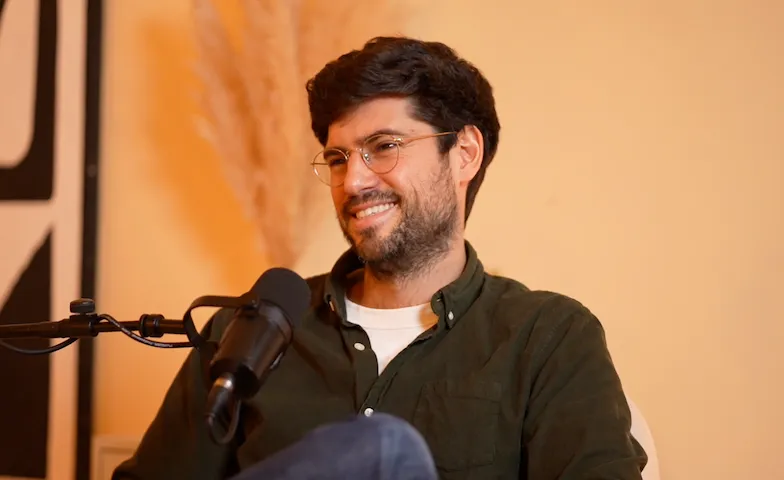
Côme Dartiguenave is the co-founder of Orus, an insurtech launched in 2021 that provides insurance solutions for freelancers and small businesses, helping them simplify complex processes. The company has grown to over 100 employees, raised a Series B, and started expanding internationally, particularly in Spain and the Netherlands.
Before founding Orus, Côme worked at Partech, one of Europe’s leading venture capital firms. After several years, he reached the end of a cycle and was on track for a partner role. At that point, he chose to step back and reflect on what he truly wanted to build. One conviction emerged: enduring companies are not built around opportunities, but around problems worth exploring in depth. This mindset led him to partner with Tom, whom he met at Partech. Together, they analyzed the structural frictions of professional insurtech, gradually shaping a conviction strong enough to commit.
Hiring a late-founder CTO
Very early on, hiring a CTO became a structuring challenge for Orus. Both Côme and Tom came from venture capital and had no internal technical expertise. This created implicit pressure—to build the tech and product foundation, and to support the credibility of a fundraising process. All the conditions for a rushed hire were there, yet they chose to resist it.
Their starting point was simple: as long as the role is not precisely defined, the hire cannot be relevant. They invested time in understanding what the CTO role truly entails—speaking with experienced profiles, documenting responsibilities, and translating them into their own context.
From there, they built a demanding process. It included a structured interview framework, technical assessments conducted by CTOs from their network, and a deep analysis of candidates’ past decisions. Cultural fit was also explicitly assessed using structured tools. The level of rigor showed both in the scale of sourcing—nearly 800 profiles contacted for around 100 conversations—and in the depth of evaluation. What could have been seen as a constraint became a signal of the company’s standards and level of structuring.
Côme shares in detail the hiring of their CTO, Samuel Rosille, in a full case study available here.
Key takeaways:
– Take the time to define the role concretely: speak with CTOs, document, compare, then translate into your own context, clarifying responsibilities, boundaries, and timing
– Build an evaluation process that doesn’t rely on intuition: structure interviews, involve peers for technical assessment, and analyze past decisions beyond outcomes
– Make cultural fit observable: organize a full-day process, use structured questionnaires on management style, strengths and areas for improvement, address potential concerns explicitly, and include informal moments to observe interactions outside the interview setting
Côme emphasizes that assessing cultural fit requires prior work on defining the company’s culture itself, to ensure alignment between evaluation criteria and actual practices.
How do you hire without a product?
“You need to be so convinced by the candidate that you become convincing yourself.”
At launch, Orus was hiring without a product. The absence of tangible proof shifts the challenge toward making the project credible—without relying on vague or inflated narratives. The approach is direct and transparent.
While the profiles targeted have an entrepreneurial mindset, the core challenge lies in building conviction. This starts with a precise definition of the role—why this person, why now—and extends to explicitly addressing potential concerns. Rather than avoiding objections, they surface them through a systematic question: “What could make you decide not to join us?” This brings out concrete concerns—risk, career trajectory, management quality—which can then be addressed directly.
Key takeaways:
– Be precise about the role and timing: clearly articulate why the hire matters now
– Surface objections early: explicitly ask about concerns to address real issues
– Create decision moments beyond evaluation: informal interactions (lunch, dinner) help candidates project themselves and decide
– Accept that not everyone will join: without product or proof, hiring relies on individuals comfortable with uncertainty
Define the need and success conditions before hiring
“A person will not perform equally, even with the same skills, depending on the environment.”
At Orus, hiring never starts from the profile—it starts from the problem. The key question is: what problem does this role solve, and why now? This requires clarifying not only the purpose of the role, but also the conditions in which the person will operate.
This approach avoids a common bias: hiring reflexively, without validating the actual need or ensuring the environment is ready.
The role is then defined operationally—skills, responsibilities, expected outputs, execution context. This allows for a clear distinction between a good and an excellent profile, based on the company’s stage and the reality of the role, rather than purely on past experience.
For Côme, this level of rigor translates into time: up to 30 hours per week dedicated to interviews during key phases. Hiring is treated as an operational priority, on par with other performance levers.
Key takeaways:
– Start from the problem, not the role: clearly define what needs to be solved
– Explore alternatives before opening a role: assess whether the need can be handled internally or outsourced
– Define the role operationally: skills, responsibilities, expectations, execution conditions
– Distinguish excellent from good: based on company stage, real scope, and execution environment
– Make hiring a true priority: dedicate significant time, up to 30 hours per week in key phases
Expanding internationally: starting from scratch, not scaling
“When entering a new market, you need the humility to start from zero.”
Orus launched Spain just before its Series B, with a pragmatic approach. The market was initially tested without setting up a local structure. Early hires, particularly in sales, were made from Paris to maintain cultural consistency and avoid premature fragmentation. Spanish hires were initially integrated at headquarters.
This setup quickly showed its limits. Entering a new market raises specific challenges—understanding local dynamics, adapting the go-to-market, structuring teams, and managing operations. The conclusion was clear: international expansion cannot be treated as a side project. It impacts the entire organization and requires the same level of priority as the core market.
It also requires accepting a reset: building a new product-market fit, identifying local leverage points, and structuring operations progressively.
With the Series B and additional resources, Orus accelerated its expansion. However, there is no universal playbook—each market requires its own analysis and approach.
This is particularly true for the Netherlands. In a more competitive environment, the approach is more aggressive: faster launch, more senior hires, and local presence from day one.
Key takeaways:
– Don’t treat international expansion as a side project: it requires full organizational alignment and prioritization
– Start centralized to maintain consistency: hire from HQ before moving to local setup
– Accept starting from scratch: rebuild product-market fit instead of duplicating processes
– Anticipate organizational impact: structure key roles, including country leadership, local teams, and support functions