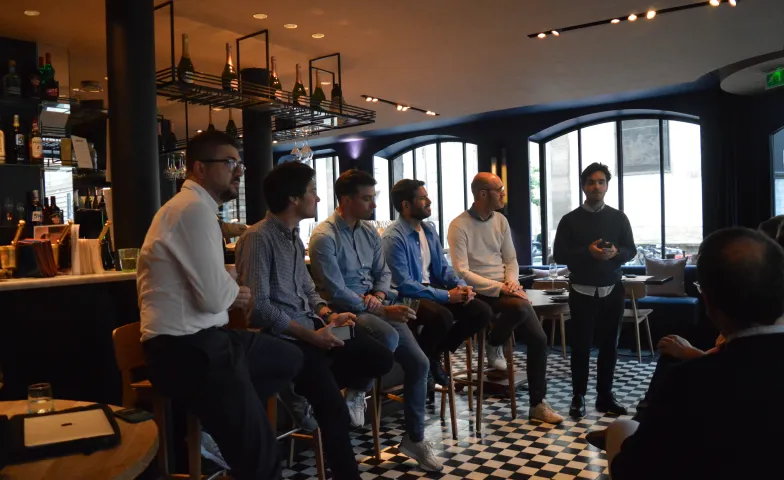

Nicolas Fayon is the CEO and co-founder of Jump, launched in 2021 to give freelancers access to the protections and benefits of salaried employment without having to set up their own company. Since its launch, Jump has raised €15 million, including an €11 million Series A led by Breega, and now has a team of more than 70 people working towards that mission.
The idea behind Jump emerged from two major shifts in the world of work. On the one hand, a growing desire for greater freedom and flexibility, accelerated by the Covid pandemic. On the other, technological advances that are enabling a new generation to build businesses and launch products with far fewer resources than in the past.
For Nicolas, freelancers increasingly want the freedom to work on their own terms without giving up financial security, pension rights or the ability to buy a home. This is exactly the gap Jump is looking to bridge: giving freelancers the benefits of salaried employment while allowing them to retain their independence.
The future of work: towards a more fragmented workforce
Nicolas believes the world of work will continue to become more fragmented, driven by two forces: younger generations expecting greater flexibility, and technology making it significantly easier to start and run a business. The Covid pandemic accelerated this shift, prompting many people to rethink the role work plays in their lives, where they want to live and how they want to work.
Yet greater freedom does not eliminate the need for security. The challenge is therefore to build new models that can combine the two. Technology is likely to accelerate this transition further by giving more people the tools to build businesses and work independently.
From the first hires to building a better framework for hiring decisions
“Every hire is an opportunity to refine the way you make hiring decisions.”
Jump started with four co-founders whose skills complemented one another across engineering, operations, sales and partnerships, product, and marketing. Following the launch of its first MVP, the company grew quickly and raised several million euros to build out the team. Its first hires were focused on filling key capability gaps, particularly in Customer Success and payroll.
Initially, Nicolas and his co-founders placed significant weight on candidates’ academic and professional backgrounds. Over time, however, they realised that credentials alone were not enough to predict whether someone would succeed at Jump.
Experience gradually led them to focus more closely on qualities such as energy, resilience, loyalty and alignment with the company’s values. Some hires directly challenged their assumptions about what makes a strong candidate. A Growth hire with a strong reputation and recognised expertise, for example, did not deliver the expected results. By contrast, a VP Product proved capable of expanding his scope significantly, eventually taking responsibility for the Engineering teams as well.
These two very different outcomes reinforced Nicolas’s view that experience and perceived expertise alone are poor predictors of success. Each hire has helped Jump refine what it looks for and how those qualities are assessed throughout the recruitment process.
Key takeaways
- When you first start hiring, the priority should be to complement the founding team with the capabilities the business genuinely needs at each stage.
- Academic and professional backgrounds are not strong enough predictors of success on their own. Soft skills matter just as much.
- A good way to improve hiring decisions is to identify the qualities shared by people who thrive within the company and build those into the assessment process.
- Reputation, credentials and other signals of authority should be treated with some caution: they can easily carry more weight in a hiring decision than what has actually been assessed in the candidate.
- Every hire is an opportunity to sharpen your search and assessment criteria.
AI will reshape hiring needs
At Jump, the impact of artificial intelligence is already tangible. Internally developed tools are automating some low-value tasks and increasing the capacity of existing teams. In the past, a growing customer base meant regularly adding headcount to the Customer Success team. Today, these tools allow the company to handle more activity with the same resources while enabling employees to focus on higher-value work.
Nicolas expects this shift to naturally reduce the need for some operational hires while creating demand for new roles, particularly around data and the governance of AI use. It is also bringing a new quality to the forefront in hiring: curiosity. Nicolas does not expect every candidate to be an expert in these tools, but he increasingly sees the willingness and ability to understand them, experiment with them and adapt as essential.
Key takeaways
- AI can automate repetitive tasks and reduce some of the additional hiring traditionally required to support growth.
- As roles evolve, new needs are emerging, particularly around data.
- Curiosity and adaptability are becoming critical hiring criteria as tools and ways of working evolve rapidly.
Hiring: setting a high bar
Looking back, Nicolas reflects on a period when Jump hired very quickly, before the more challenging funding environment from 2022 onwards forced the company to reduce the size of its team. His biggest takeaway has been to become far more selective about every hire.
Today, he personally meets every candidate who reaches the recruitment process and invests time in sharing Jump’s vision with new joiners.
His advice to early-stage founders is to look for people they can still imagine having alongside them five or ten years down the line: people who can evolve as the company grows, who genuinely want to build, and who have the resilience to navigate the different stages of a company’s development. Rather than simply hiring the best candidate for the immediate need, the goal is to find people who can grow with the company.
Key takeaways
- Rapid growth or access to significant funding should not lead companies to hire faster than necessary: quality over quantity.
- Founder involvement can significantly improve the quality of key hires. Up to a certain stage, leaders should remain closely involved to help ensure that new hires are successfully integrated into the company.
- Sharing the company’s vision helps new joiners understand not only the role they are taking on, but the broader journey they are joining.